
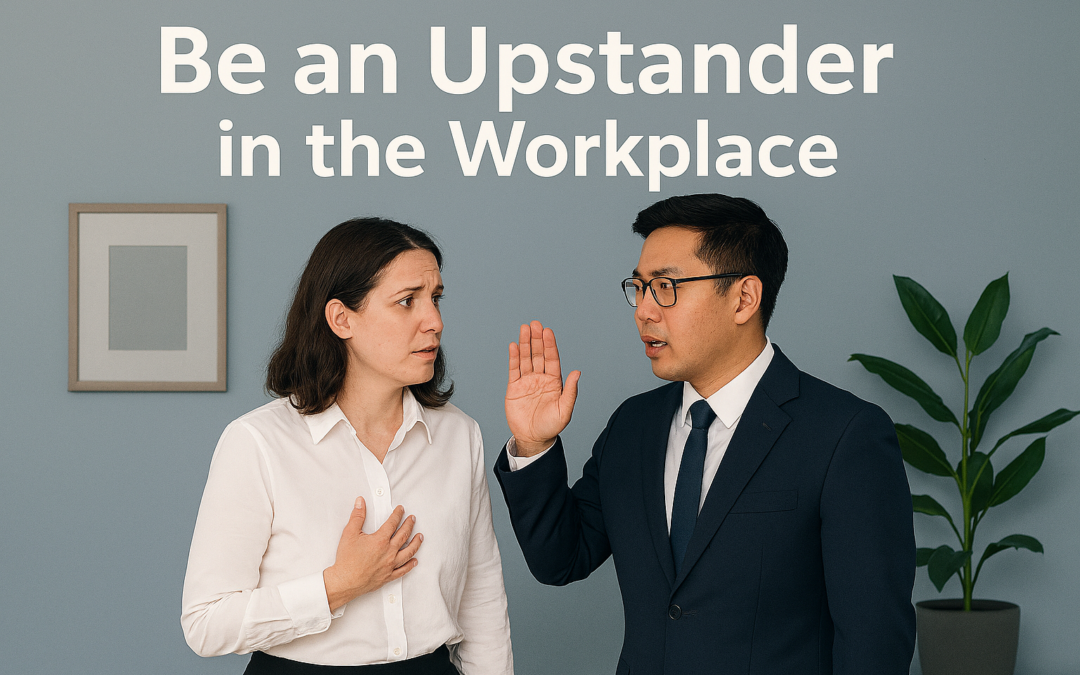
For a long time, my guidance to organizations has been clear:
Train employees to be strong bystanders. I discuss this in our trainings and I highlight the importance:
See something. Say something. Use the reporting process.
That work matters. It created safer pathways, more consistency, and better compliance.
But after the number of workplace investigations and culture resets I’ve supported, I’ve had to admit something:
Everyone usually sees the behavior.
Very few people address it in the moment.
That’s not an awareness problem.
That’s a culture design problem.
We’ve trained employees to report issues, but not to uphold the standard in real time.
And that’s the shift I’m making in my work going forward.
Bystander behavior is still the baseline. BUT, Upstander behavior is the next level of a healthy workplace culture. I think back to my parenting, if my kids see something clearly wrong, I don’t just want them to get a teacher. I want them to feel empowered to stand up for what is right to others in that exact moment. I want my kids to be upstanders.
Because bystanders support the process.
Upstanders protect people.
A bystander reports the inappropriate comment after the meeting.
An upstander says:
“Let’s keep this respectful.”
“That didn’t land the way you intended.”
“We don’t talk about people like that here.”
Not confrontational. Not policing. Just clear, shared ownership of team norms.
In the strongest cultures I work with, HR is not the first line of defense, the team is.
That’s when you see:
- Higher trust
- Faster behavior correction
- Less fear of retaliation
- Fewer formal complaints
- Managers who aren’t carrying culture alone
This is also a leadership shift.
We cannot ask employees to speak up in real time if leaders can’t receive feedback without defensiveness. Upstander cultures require leaders who model:
“Good call, let’s reset.”
“Thank you for saying that.”
“You are right.”
So going forward, when I partner with clients on employee experience and workplace culture:
Yes, we will still build strong reporting structures.
Yes, we will still train on bystander awareness.
But we will also:
- Teach employees how to redirect behavior in the moment
- Give teams shared language to uphold their values
- Make peer-to-peer accountability part of the culture
Because the healthiest workplaces aren’t the ones with the best investigation process.
They’re the ones where fewer investigations are needed,
because someone resets the room when something goes sideways.
Bystanders helped us build awareness.
Upstanders build the culture.
And that’s the standard I’m committed to helping organizations reach.
Want to drive this home for your team? Reach out to discuss how we can incorporate these values into your culture.