
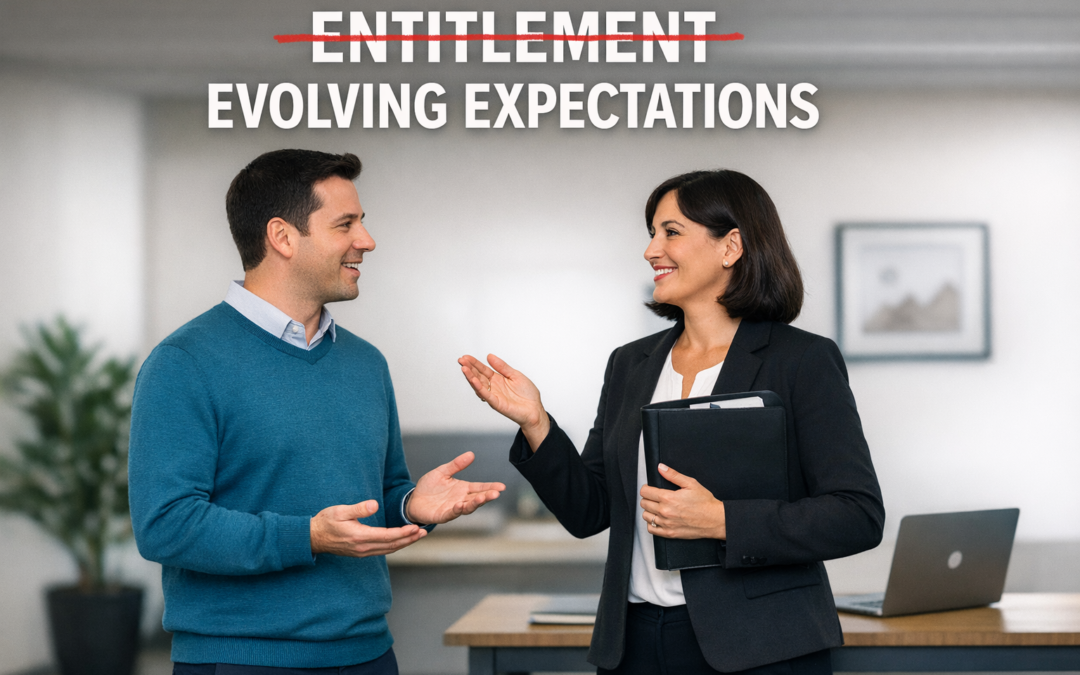
If you spend any time talking with small business owners, you’ll eventually hear a version of this sentence:
“Employees these days are so entitled.”
It pops up around PTO requests, flexibility, compensation, work‑life boundaries, mental health accommodations, remote work preferences, and feedback culture.
But here’s the question I always ask:
Is it actually entitlement?
Or are employee expectations evolving — and pushing businesses to evolve with them?
Spoiler: It’s usually the second one.
Let’s break it down.
1. What People Call “Entitlement” Is Often Just Clarity
Employees today tend to be very clear about what they need:
- Work-life balance
- Competitive pay
- Respectful communication
- Real development opportunities
- Flexibility where the job allows
Is that entitlement?
Or is it a generation of workers finally willing to say out loud what past generations quietly endured?
Clear expectations aren’t unreasonable — they’re efficient.
Businesses that understand this stop taking the requests personally and start incorporating them operationally.
2. Technology Changed the Game — And Expectations
Employees know what other companies are offering because:
- Job postings list benefits openly
- Pay transparency laws made compensation visible
- Workers can compare internal norms to external norms instantly
- Social platforms normalize flexible, healthy workplace cultures
When people have access to more information, they raise questions they didn’t ask before. That’s not entitlement.
That’s awareness.
3. Burnout Isn’t a Buzzword — People Are Actually Tired
The last decade has brought:
- Economic instability
- Inflated workloads
- Constant digital connectedness
- Skyrocketing costs of living
- Health and caregiving responsibilities that hit small teams hard
Employees asking for reasonable boundaries or balance aren’t being difficult — they’re trying to stay sustainable.
Businesses that take this seriously don’t crumble. They stabilize.
4. Accountability Isn’t One‑Sided Anymore
Older workplace models put nearly all the accountability on the employee:
- Show up
- Don’t complain
- Don’t ask questions
- Be grateful
Today’s workforce believes accountability runs both ways:
- Employers must communicate clearly
- Managers must manage consistently
- Workplaces must operate with fairness
That shift can feel like “pushback” if you’re used to a one-direction model.
But it often leads to stronger systems, more predictable operations, and fewer HR fires.
5. Flexibility Isn’t a Luxury Anymore, It’s a Business Strategy
When employees ask for flexibility, many employers interpret it as:
“They want special treatment.”
But flexibility (within reason) usually leads to:
- Better productivity
- Lower turnover
- Higher engagement
- More loyalty
Rigid work structures don’t make businesses better.
Adaptive ones do.
“Flexibility” isn’t entitlement. It’s a performance tool.
6. Employees Want to Work Somewhere That Works Well
Here’s the biggest misconception:
Employees aren’t less hardworking.
They’re less willing to tolerate:
- Chaos
- Poor planning
- Last‑minute emergencies
- Unclear expectations
- Outdated leadership
And honestly? That’s a compliment.
It means people want to work in a workplace that works.
When employees speak up, they’re not trying to make your job harder — they’re showing you where your systems need strengthening.
That’s not entitlement.
That’s real‑time diagnostic data.
7. Evolved Expectations Push Businesses to Level Up
Small businesses often grow in two ways:
- Intentionally — by proactively improving systems
- Reactively — because employees demanded better
Both lead to growth.
But the second one is often mislabeled as “entitlement.”
In reality, employees asking for clarity, structure, boundaries, or modernized practices is usually a sign that your business is reaching the point where it needs to grow up operationally.
Employee expectations aren’t the obstacle.
They’re the invitation.
The Bottom Line
Employees aren’t more entitled.
They’re more aware, more communicative, and more willing to ask for workplaces that operate with dignity and structure.
And when businesses listen?
- Culture improves
- Retention stabilizes
- Hiring gets easier
- Managers get better
- The business matures
Employee expectations don’t lower the bar —
they raise it.
And they push your business right along with it.